


What is tone?
Tone is how we respond to our customers’ emotions in a particular situation. Our voice is consistent (we’re always warm, confident, and genuine), but our tone changes depending on the type of info we’re delivering and how the customer is likely to feel about it.
To strike the right tone, ask yourself:
- Who is this for?
- How often will a customer see it?
- What is the customer’s goal, or what have they just done?
- What might they be feeling?
- How focused are they (for example, are they multitasking or using their phone on public transportation)?
- How critical is the content?
When to flex tone
Tone shifts based on the content (what you have to say), the context (what else is happening when you say it), and the audience (who you have to say it to). It depends on what the customer needs at that moment, and how they’re going to encounter the info we’re providing.
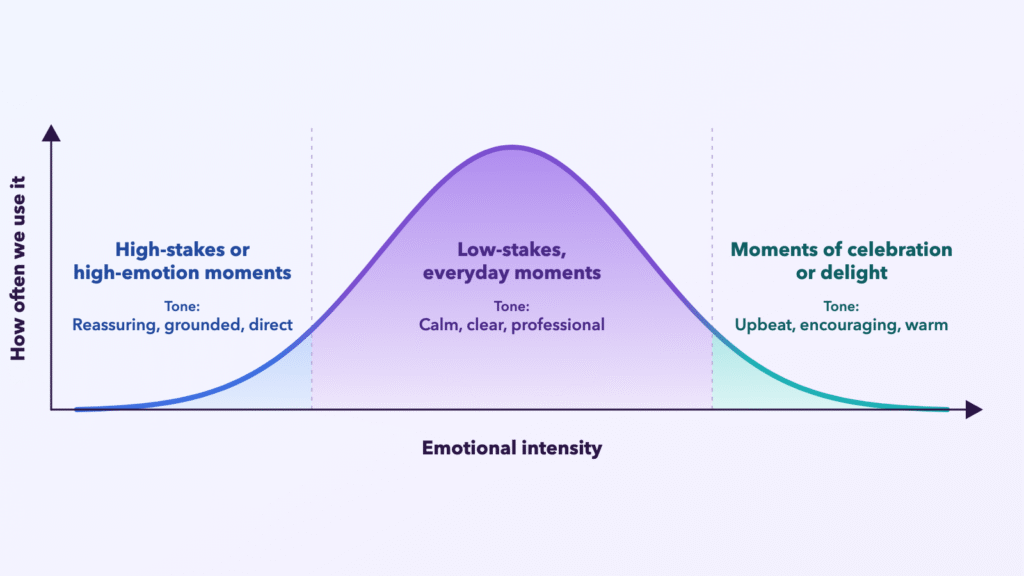
Picture tone on a bell curve. Most of the time, content should fall in the middle and be calm, clear, and professional. Sometimes, when something specific is happening, your tone will move to the edges: In high-stakes or high-emotion moments, you’ll want to sound more reassuring. For moments of celebration or delight, you’ll sound more upbeat.
But these occasions are rare. If you move too far in either direction too often, customers can no longer tell what’s significant, because everything sounds equally urgent or equally exciting.
Low-stakes, everyday moments

Tone: Calm, clear, professional
Customer mindset: Focused, neutral, and task-oriented. They want to get work done quickly without unnecessary conversational friction. Being calm avoids artificial urgency, being clear removes ambiguity, and staying professional respects their competence and their time.
When to use:
- The customer is focused on completing a standard task or workflow
- The emotional stakes and risks are low
- Something small went wrong, but the fix is quick, obvious, and painless
- We’re explaining a feature, setting expectations, or providing factual updates
Where this could show up:
- Tooltips explaining standard features, inline form validation, status confirmations, button labels. See also: Tooltips
- Routine payment receipts or updates, account summaries, feature rollout emails
- Support articles, standard FAQ pages, release notes

“We couldn’t connect your bank. Try again, or add it manually.”
- Nothing is at risk here, so we focus on the recovery path, not the friction. Give the customer a way forward.
“Invoice sent.”
- For everyday tasks, efficiency is empathy. Success messages confirm that an action is complete, then get out of the way.

“Great job! Your invoice was sent.”
- “Great job!” is praise for a routine task. Applauding routine actions feels patronizing and dilutes the impact of genuine celebrations for major milestones.
“It’s currently the quiet hour, so we can’t send messages right now. We’ll schedule your campaign to send as soon as the quiet hour is over.”
- This message explains the delay using plain language. Stating the cause and next step shows composure and confirms the system is working as intended. Nothing went wrong, so there’s no apology.
“At this juncture, due to the fact that it is the designated quiet hour, we are unable to send your message. We will arrange for your campaign to be sent out as soon as the quiet hour has elapsed.”
- While this is grammatically correct, the formal wording (“At this juncture,” “due to the fact that,” “we will arrange”) comes off as defensive and bureaucratic. It makes a routine delay sound like a violation or policy notice.
“We have experts available to connect now. They’re reviewing your info and will call you in about 5 min.”
- This is a status update that delivers the specific, actionable expectation (the time window) so the customer can plan their next move.
“The experts we have are ready and waiting to connect with you as soon as possible. They are diligently going over your information right now and will aim to give you a call in approximately five minutes.”
- “Ready and waiting,” “diligently,” and “aim to” read as performative effort and self-congratulatory. Describing how hard or diligently teams work doesn’t add value. Customers care about the outcome, not the internal hustle.
High-stakes or high-emotion moments

Tone: Reassuring, grounded, direct
Customer mindset: Anxious, stressed, or alarmed. They feel vulnerable because something went wrong or an irreversible decision is on the line. They aren’t looking for robotic detachment, corporate jargon, or panic-inducing exclamation points. They want to know what happened and what to do next.
When stakes are high, we de-escalate and give them back control. We don’t downplay the problem or apologize defensively. See also: Notifications, Bad news, Errors, Security and data
When to use:
- Money is directly involved and an action didn’t go as expected
- A hard deadline (taxes, payroll, compliance) is approaching or has passed
- An action could negatively affect their legal standing, employees, or business operations
- The customer is about to delete critical data or make a change they can’t undo
- Account security, access, or sensitive customer data is at risk
Quick test: Could the customer lose money, miss a deadline, or compromise sensitive data if this goes wrong? If yes, flex to reassuring.
Where this could show up:
- Critical failure messages, destructive action modals, re-authentication security challenges
- Urgent payment failure notices, security alerts, hard deadline reminders
- Frontline support, escalation emails, incident status page updates during an outage
- Formal notices about terms of service that could affect liability, price increases
“Your payroll didn’t go through, so your team hasn’t been paid yet. Retry now, or review what went wrong.”
- Naming the human impact (“your team hasn’t been paid”) shows we understand the gravity, while immediate self-serve paths restore control and de-escalate panic.
“Payroll failed. Retry or contact support.”
- While technically accurate, this is too robotic and clinical for a situation where the customer’s employees haven’t been paid.
“Based on your upcoming bills, you may be short on cash by June 14. Here’s what you can do now.”
- This message anchors risk with specifics and proactive agency. Concrete info (the date and the cause) replaces vague anxiety with facts, giving the customer something to act on.
“Your cash flow is about to run out!”
- “About to run out!” triggers a jolt of alarm without context or next steps. In high-stakes moments, we want to shift a customer’s mental state from panic to problem-solving.
“Your expert needs more time to finish your taxes before the April 15 deadline. We can help you file a free federal extension, or you can file your taxes yourself.”
- When deadlines are at risk, plain language and direct support (“we can help you”) reduce cognitive load and turn something upsetting into an actionable partnership.
“The expert assigned to you needs additional time to complete your return before the April 15 tax deadline. You have the option to file a federal extension for free, or to file your taxes on your own.”
- This might be technically accurate, but the passive formality adds institutional distance and creates isolation when a customer needs reassurance.
Moments of celebration or delight

Tone: Upbeat, encouraging, warm
Customer mindset: Relieved, accomplished, or proud. They just finished something long or stressful, or reached a meaningful milestone. They want to feel validated for their effort, but are quick to spot hollow, corporate hype.
We celebrate their achievements, not our products. The enthusiasm should match the size of the moment. See also: Celebrations
When to use:
- The customer reached a first-time milestone, such as first invoice paid or first payroll run. See also: Empty states
- They reached a specific goal they set for themselves
- They finished something long, demanding, or stressful, like filing a return or finishing account setup
- They received unexpected good news, like a larger refund estimate
- It’s a moment they don’t have every day
Where this could show up:
- Onboarding completion screens
- Milestone badges, notifications, or emails
- Activation or welcome emails
“Return filed! That’s it, you’re done for this year.”
- For exhausting or anxiety-inducing milestones, the dominant emotion is relief, not excitement. Confirming it’s done validates their hard work and lets them mentally close the chapter.
“Nice work! You just crushed tax season!”
- “Crushed tax season!” is slangy, performative enthusiasm. When a process was tedious and stressful, this kind of hype feels disconnected and tone-deaf.
“You hit your $500 goal. Nice work!”
- We typically advise against exclamation points, but a milestone is one place where it fits. Highlighting the metric alongside a single note of genuine praise gives the milestone weight.
“Amazing! You hit your $500 goal!”
- Shouting “Amazing!” with stacked exclamation points treats a planned financial target like an unexpected miracle. Overpraising standard progress feels patronizing, not empowering.
“You started your taxes. Next, add your income.”
- At the start of a complex journey, the customer needs grounding. Starting isn’t an achievement yet. Showing where they stand and what comes next fosters focus and confidence.
“You started your taxes. Time for a happy dance!”
- Throwing confetti for simply opening a workflow interrupts focus and steals emotional payoff from the real finish line.
“Password updated.”
- Account hygiene requires zero emotional processing. Changing a password is routine, so the customer needs only a confirmation. See also: Confirmations
“Password updated. Well done, Anne!”
- Watch out for false celebrations on operational chores. Praising a routine task cheapens the moments that deserve it.
